
How Finish Carpentry and Custom Cabinets Work Together to Create Beautiful, Functional Living Spaces
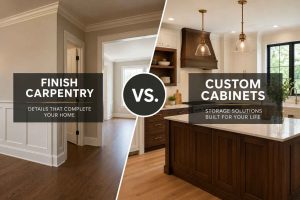
Homeowners planning a remodeling project often hear the terms finish carpentry and custom cabinetry used interchangeably. While the two services frequently complement one another, they serve different purposes and require distinct skills. Understanding where each one fits within a renovation can make it easier to plan the project, communicate with a contractor, and establish realistic expectations for both the timeline and budget.
Finish carpentry focuses on the architectural details that complete a room, while custom cabinetry centers on creating personalized storage solutions built specifically for the home’s layout and the homeowner’s lifestyle. Together, they transform a renovated space from structurally complete into visually refined and highly functional.
Whether you’re remodeling a kitchen, upgrading a bathroom, or renovating an entire home, understanding the relationship between these two trades helps ensure every element works together seamlessly.
What Is Finish Carpentry?
Finish carpentry is the final stage of woodworking performed after the major construction work has been completed. Once framing, drywall, flooring, and primary installations are finished, finish carpenters install the visible wood details that give a room its polished appearance.
Unlike rough carpentry, which focuses on structural components hidden behind walls, finish carpentry emphasizes precision, clean lines, and craftsmanship. Every cut, joint, and measurement remains visible, requiring a high level of accuracy and attention to detail.
These finishing touches not only improve appearance but also create smooth transitions between walls, ceilings, floors, doors, and windows.
Common Finish Carpentry Features
| Finish Carpentry Element | Purpose |
|---|---|
| Baseboards | Protect walls while creating a finished transition to flooring |
| Crown Molding | Adds architectural character where walls meet ceilings |
| Door Casings | Frames doors with clean, decorative trim |
| Window Trim | Creates a finished appearance around windows |
| Decorative Wall Molding | Adds visual depth and architectural interest |
| Interior Trim | Connects different building materials seamlessly |
Although these details may seem subtle individually, together they define the overall quality and craftsmanship of a finished interior.
What Are Custom Cabinets?
Custom cabinets are built specifically for the dimensions, layout, and storage needs of an individual home. Instead of selecting pre-manufactured cabinet sizes, homeowners work with experienced carpenters to design cabinetry that fits both the available space and the way the household functions.
Every project begins with precise measurements, allowing cabinets to fit perfectly regardless of unusual room layouts, ceiling heights, or architectural features. This personalized approach creates storage solutions that maximize usable space while complementing the home’s overall design.
Unlike stock cabinets, custom cabinetry gives homeowners complete control over materials, finishes, hardware, drawer configurations, shelving, and organizational accessories.
The result is storage that feels integrated into the home’s architecture rather than simply installed within it.
Where Custom Cabinets Are Commonly Installed
Although kitchens remain the most popular location for custom cabinetry, built-in storage can improve organization throughout the home.
| Room | Purpose of Custom Cabinetry |
|---|---|
| Kitchen | Pantry storage, cookware organization, appliance integration |
| Bathroom | Vanities, linen storage, and personal care organization |
| Laundry Room | Cabinets for cleaning supplies and household essentials |
| Home Office | Built-in shelving, filing cabinets, and workstation storage |
| Living Room | Entertainment centers and decorative built-ins |
| Mudroom | Lockers, benches, shoe storage, and cubbies |
Because every cabinet is designed specifically for the space, homeowners can make better use of corners, alcoves, and other areas where standard cabinets may leave unused gaps.
The Biggest Difference Between the Two
Although finish carpentry and custom cabinetry are closely related, their primary objectives are different.
Finish carpentry focuses on enhancing the architectural appearance of a room. It provides the decorative trim and finishing details that make walls, ceilings, doors, and flooring feel complete.
Custom cabinetry, on the other hand, is designed to improve storage, organization, and functionality. Cabinets become permanent fixtures that serve practical purposes while also contributing to the room’s visual appeal.
One emphasizes finishing details.
The other creates personalized storage systems.
Both are essential for achieving a cohesive remodeling project.
| Finish Carpentry | Custom Cabinets |
|---|---|
| Decorative woodwork | Built-in storage solutions |
| Installed during the final phase | Designed early in the remodeling process |
| Improves architectural appearance | Improves functionality and organization |
| Includes trim and molding | Includes cabinets, drawers, and shelving |
| Primarily aesthetic | Combines aesthetics with everyday usability |
How They Work Together During a Remodeling Project
Rather than treating finish carpentry and custom cabinetry as separate services, experienced remodeling contractors plan them together from the beginning.
In a typical kitchen renovation, for example, the cabinetry establishes the overall layout of the room. Once cabinets have been installed and carefully leveled, finish carpenters complete the surrounding architectural details. Crown molding above upper cabinets, filler panels, decorative trim, toe kicks, and window casings all contribute to a seamless finished appearance.
Because both trades influence one another, coordinating them during the design phase helps eliminate unnecessary adjustments later in the project.
The result is a space where every transition feels intentional and every detail appears professionally integrated.
Why Sequencing Matters
The order in which these services are performed has a direct impact on the final quality of the renovation. Installing finish trim before cabinetry, for example, can create alignment issues or require unnecessary modifications once cabinets are in place.
Most professional remodeling projects follow a sequence similar to the one below.
| Remodeling Phase | Primary Work |
|---|---|
| Construction | Framing, drywall, electrical, plumbing |
| Flooring | Installation of finished flooring |
| Cabinet Installation | Base cabinets, wall cabinets, built-ins |
| Finish Carpentry | Trim, molding, casings, decorative details |
| Final Adjustments | Touch-ups, painting, hardware installation |
Following this sequence allows finish carpentry to be customized around the cabinetry rather than forcing cabinetry to fit previously installed trim.
This approach produces cleaner lines, tighter joints, and a far more refined finished product.
Where Finish Carpentry and Custom Cabinets Overlap
Although these services have different primary objectives, they frequently intersect throughout a remodeling project. In many cases, the final appearance of custom cabinetry depends on the quality of the finish carpentry surrounding it.
Trim pieces, crown molding, filler panels, toe kicks, decorative end panels, and seamless transitions all help cabinetry appear as though it was originally built with the home rather than added during a renovation.
This is why homeowners often choose a contractor who provides both services. When the same team designs, builds, and finishes the project, the materials, proportions, and craftsmanship remain consistent from start to finish.
Which Service Does Your Project Need?
The answer depends on the goals of your renovation. Some projects only require updated trim and molding to refresh the appearance of a room, while others involve replacing outdated cabinetry to improve storage and functionality.
Many remodeling projects, however, benefit from combining both services.
The comparison below can help homeowners better understand which solution fits their needs.
| If Your Goal Is… | Finish Carpentry | Custom Cabinets |
|---|---|---|
| Update decorative trim | ✔ | |
| Install crown molding | ✔ | |
| Replace baseboards | ✔ | |
| Improve storage | ✔ | |
| Add built-in shelving | ✔ | |
| Remodel a kitchen | ✔ | ✔ |
| Upgrade a bathroom | ✔ | ✔ |
| Create a home office | ✔ | ✔ |
Thinking about the project from the beginning allows homeowners to prioritize both functionality and appearance without overlooking important finishing details.
Benefits of Planning Both Services Together
One of the biggest advantages of coordinating finish carpentry and custom cabinetry is achieving a unified design. Rather than selecting cabinets first and trim later, both elements can be designed to complement each other in terms of style, proportions, colors, and materials.
This approach also improves efficiency during construction. Measurements are more accurate, installation progresses more smoothly, and the finished project requires fewer adjustments after the fact.
Homeowners also benefit from a more cohesive aesthetic. Matching moldings, consistent wood species, coordinated finishes, and carefully planned transitions create interiors that feel professionally designed rather than assembled from separate components.
| Benefit | Why It Matters |
|---|---|
| Consistent design | Creates a cohesive appearance throughout the room |
| Better project coordination | Reduces delays and installation conflicts |
| Improved craftsmanship | Allows every detail to be customized together |
| Greater efficiency | Minimizes rework during installation |
| Higher long-term value | Produces a premium finished result |
Why Professional Craftsmanship Makes a Difference
Both finish carpentry and custom cabinetry demand precision that goes beyond standard construction practices. Small inconsistencies in measurements or installation become immediately visible because these elements remain exposed as part of the finished home.
Experienced carpenters understand how wood expands and contracts, how walls and floors may vary slightly from square, and how to achieve clean, seamless transitions even in older homes with irregular dimensions.
This level of craftsmanship contributes not only to appearance but also to durability. Properly installed trim remains secure, cabinet doors stay aligned, and drawers continue operating smoothly for many years with minimal maintenance.
Choosing skilled professionals helps ensure the finished work performs as beautifully as it looks.
Common Misconceptions About Finish Carpentry and Custom Cabinets
Because these services often appear together during remodeling projects, homeowners sometimes misunderstand what each one includes. Clarifying these misconceptions can make planning much easier.
| Common Misconception | Reality |
|---|---|
| Finish carpentry includes building cabinets. | Finish carpentry focuses on trim and architectural details, while cabinetry is its own specialty. |
| Stock cabinets and custom cabinets perform the same. | Custom cabinets maximize space, improve organization, and fit the home’s exact dimensions. |
| Trim is only decorative. | Finish carpentry also creates clean transitions and protects edges while improving overall durability. |
| Cabinets can be installed at any stage. | Cabinetry is carefully sequenced before much of the finish carpentry begins. |
Understanding these differences helps homeowners make informed decisions and communicate more effectively during the design process.
Final Thoughts
Finish carpentry and custom cabinetry each play an important role in creating beautiful, functional living spaces. While finish carpentry provides the architectural details that complete a room, custom cabinets deliver personalized storage designed around the way homeowners live.
Rather than viewing them as separate services, it’s helpful to think of them as complementary parts of the same remodeling process. Together, they improve organization, elevate craftsmanship, and create interiors that feel cohesive from every angle.
Whether you’re renovating a single room or planning a larger home improvement project, investing in quality carpentry and thoughtfully designed cabinetry can enhance both everyday comfort and the long-term value of your home.
Ready to Start Your Remodeling Project?
Whether you’re planning custom cabinets, finish carpentry, or a complete remodeling project, Will’s Carpenter LLC delivers expert craftsmanship tailored to your home’s unique style and functional needs. Contact our team today to schedule a free consultation and discuss your vision.